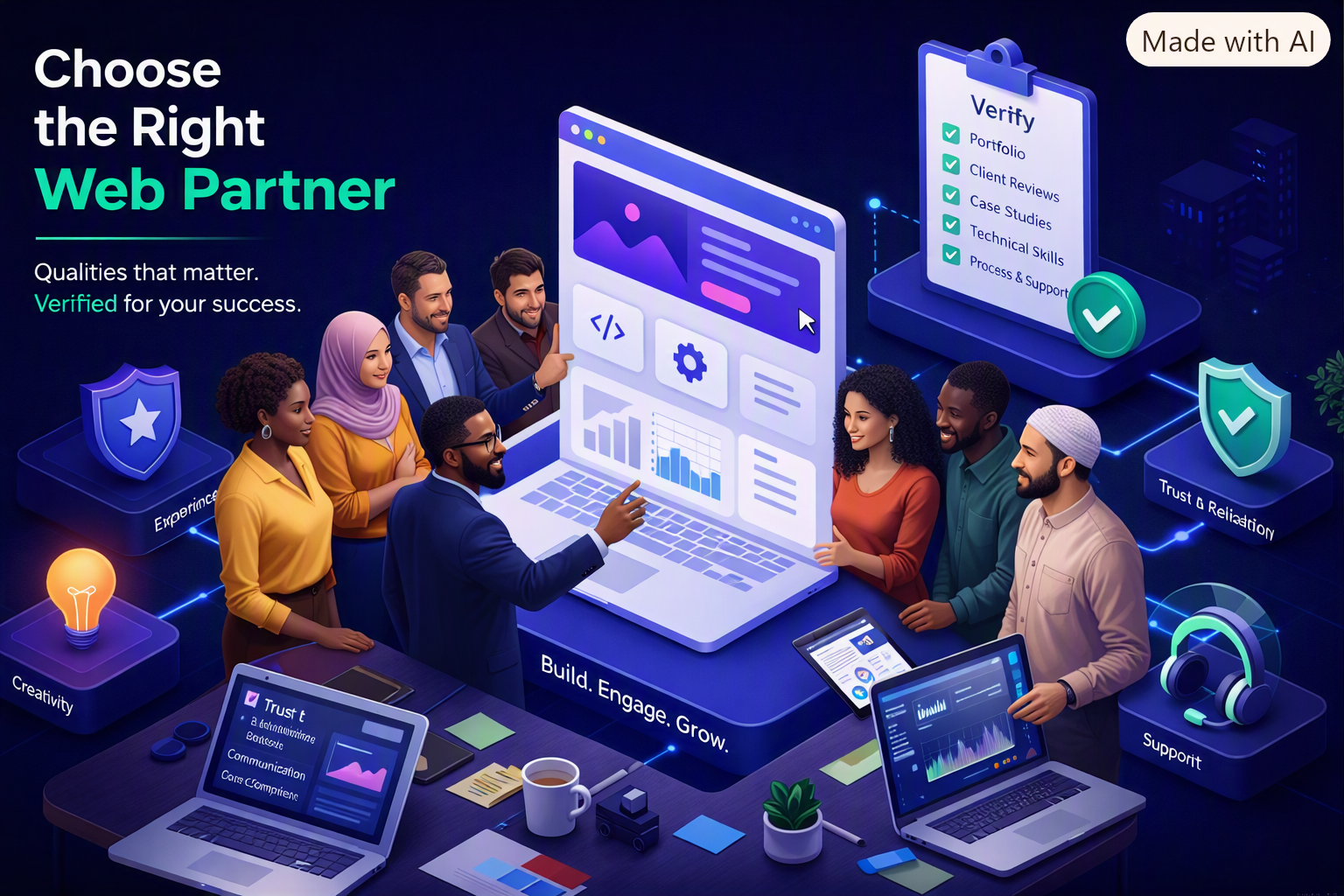
Most small business owners start their search for a website creation company the wrong way. They look at a portfolio, read a few bullet points on a services page, and make a decision based on how convincing the pitch sounds. The problem is that every agency in a crowded market promises the same things: fast sites, stunning design, SEO results, and a seamless process. Those promises cost nothing to make.
The agencies that actually deliver those outcomes are identifiable, but only if you know what to look for and how to verify it. This guide gives you a practical framework for evaluating any web design company on documented evidence rather than polished marketing copy. Viral Web Solutions is an Atlanta-based web design and digital marketing agency.
What a website creation company actually does (and what you should expect)
Beyond page design: the tangible business outcomes to demand
A professionally built website is not a design project. It is a business tool, and the outcomes you should demand reflect that. A credible web design company delivers on three non-negotiables: fast load speed, mobile-first responsiveness, and on-site SEO architecture that positions your business to rank in search results. These aren’t premium add-ons; they are the baseline for any site worth building in 2026.
When those three foundations are solid, the downstream effects show up in your analytics. More of your organic search traffic arrives. Visitors stay longer because the experience works on their device. Qualified leads find you through search instead of only through referrals. Results vary by industry and baseline, but the pattern holds consistently: performance, mobile experience, and SEO structure are the levers that move the needle. If an agency presents these as upgrade options rather than standard features, that tells you exactly where your priorities rank for them.
The difference between a design shop and a digital growth partner
Some firms are purely visual. They hand you a beautiful site, close the project, and move on. Others embed SEO, conversion strategy, and content architecture into the build itself, treating your customer acquisition goals as the starting point rather than an afterthought. The difference becomes clear in the first conversation. A growth-oriented agency asks about your target customer, your current lead sources, and what success looks like at six months before it ever asks about your color palette.
Ask any agency you’re considering: “What business goal does this site need to move?” A vague answer focused on aesthetics is a signal. A specific answer tied to leads, bookings, or revenue tells you the agency understands its actual job.
The qualities that separate a strong website creation company from a mediocre one
A documented process, not just a pitch deck
Strong agencies follow a defined workflow from discovery through launch. Per 2026 agency workflow guides and project listings, a typical marketing site moves through roughly two to three weeks of discovery, three to five weeks of design, and three to four weeks of development and QA, totaling about eight to twelve weeks. An agency that can’t walk you through each phase with clear milestones and deliverables is almost certainly making it up as it goes. Ask for a sample project timeline on your first call and watch how quickly they produce one.
The process itself matters because it protects you. Strategy and structure should be locked down before visual design begins. Content should be finalized before final development. Testing should be complete before launch. That sequence prevents expensive rework and produces a site that performs from day one rather than requiring immediate fixes.
Communication standards and project transparency
Poor communication is the most common reason web projects stall, go over budget, or end in frustration. Before you sign anything, confirm who your point of contact will be, how frequently you’ll receive updates, how revision rounds are structured, and who is responsible for content delivery and approval timelines. A good agency puts those expectations in writing before work begins.
Watch for red flags in the early stages: agencies that respond only by email with multi-day delays, have no named project manager assigned, or cannot answer basic scheduling questions in a first call are signaling how the entire engagement will feel. That pattern rarely improves once a contract is signed.
Technical and SEO competence built into the build
An agency that treats SEO as a post-launch add-on doesn’t understand how modern search works. Technical SEO competence means clean code structure, proper heading hierarchy, schema markup, image optimization, Core Web Vitals compliance, and structured metadata built in from the start. One question cuts through the ambiguity: “Is SEO part of your standard build, or is it a separate service?” The answer tells you everything about how that agency thinks about search.
How to verify a website creation company’s results before you commit
How to read a portfolio the right way
A portfolio full of polished screenshots proves the agency can take attractive photos of their own work. What it doesn’t prove is performance. When you review a portfolio, look for industry-relevant projects where the agency states the client’s objective, describes its specific contribution, and connects the outcome to real business results: leads generated, bookings made, conversion rates improved. A strong portfolio shows five to eight highly relevant projects rather than a gallery of fifty unrelated ones.
Filter by your industry, your business size, and your primary goal. A local Atlanta service business should not be reassured by a portfolio that shows only e-commerce brands from other markets. Comparable work is the only proof that applies to your situation.
What a credible case study should actually contain
Run every case study through a simple checklist. Is the client named and identifiable, or is the example vague and identified only by a logo? Are the numbers clearly defined as revenue, leads, sessions, or something else? Is there a baseline and a timeframe? Does the outcome match your business model? Can the agency connect the result to its specific work rather than market conditions? The strongest case studies follow a challenge-to-results structure with a named client quote attached to that specific project. Vague success stories without attribution are a yellow flag worth noting.
Trust signals worth verifying independently
Third-party platforms like Google Business Profile, Clutch, and Trustpilot give you an independent reading on client experience. Cross-check the rating against the number and recency of reviews; a 5.0 from eight reviews three years ago carries less weight than a 4.8 from forty reviews over the past twelve months. Named testimonials that include a client’s name, company, and project context carry far more credibility than anonymous five-star ratings. Industry credentials such as Google Partner status confirm that an agency invests in staying current with the platforms they’re building for.
Apply that same standard to any agency you evaluate, including us.
What cost and timeline look like in 2026
The actual price ranges across build methods
Cost comparisons only make sense when you’re comparing equivalent scopes. DIY platforms and professional agency builds operate in very different price tiers, and knowing where each sits helps you match your budget to your actual business needs.
Per orbix.studio’s 2026 comparison, a simple small-business website typically runs $5,000 to $15,000 with a four-to-eight-week timeline. If your site is a primary sales tool or you’re competing in a crowded local market, the agency tier is where the return on investment becomes easier to justify.
What drives cost up (and what keeps it manageable)
The variables that push projects past their initial quotes include content readiness, the number of integrations, e-commerce complexity, multilingual content, post-launch support retainers, and SEO migration scope. A client who arrives with finished copy and clear brand guidelines consistently saves time and money because those elements stop being the bottleneck. Before your first agency conversation, prepare your existing content, gather brand assets, and clarify exactly which integrations the site needs to connect with. That preparation alone can keep your project on scope and on budget.
Agency vs. website builder: when each option actually makes sense
When a template platform is the right call
If you need to launch fast and your site functions primarily as a digital brochure or booking tool, a platform can be the right starting point. Wix, Squarespace, and Shopify each publish current pricing on their websites; at the time of writing, entry-level plans range from roughly $16 to $29 per month depending on the platform and feature tier. These platforms work well for consultants, restaurants, local service providers, and early-stage businesses testing their offer before committing to a custom build. The trade-off is real: design ceilings, platform dependency, and SEO limitations that become more constraining as your business grows.
When hiring a web development agency is worth the investment
A custom website creation company becomes the clear choice when your site needs to rank in competitive search results, convert visitors into qualified leads, integrate with business systems, or represent a brand at a level that builds credibility with higher-value clients. Template platforms are built for general use, not for your specific market. If your business depends on organic search traffic or your website is a primary sales tool, the return on a professionally built custom site typically justifies the higher upfront cost many times over.
What Atlanta small businesses specifically need to know
Local agency vs. national firm: the real tradeoff
A local web design company understands your market, your competition, and how Atlanta customers search. Local SEO strategy, including Google Business Profile optimization, location-specific keywords, and regional content, is easier to execute when your agency already understands how Atlanta buyers search and decide. National firms often bring strong processes, but they tend to apply generic strategies that don’t account for how buyers in Atlanta’s neighborhoods and metro-area corridors actually behave. For small businesses competing in local search, that geographic knowledge is a genuine advantage, not just a talking point.
Common pitfalls Atlanta small businesses hit when choosing a web partner
The most frequent mistakes follow a predictable pattern. Businesses choose based on price alone and end up with a slow, template-looking site that actively hurts their credibility. They sign with an agency that excludes SEO from the standard build and then discover the site isn’t ranking months later. They fail to clarify content ownership and lose access to their own assets when the relationship ends. They pay ongoing retainers with no defined deliverables or reporting, so there’s no way to measure whether the investment is working. These aren’t hypothetical scenarios; they’re exactly the situations that lead businesses to look for a more reliable partner.
How to take the next step with the right partner
At Viral Web Solutions, we’ve spent over a decade building fast, SEO-optimized, mobile-first websites for small businesses in Atlanta. Our work is focused entirely on small business growth, and our custom web design and digital marketing services are built around the outcomes that actually matter: organic visibility, qualified leads, and a site that represents your brand at its best. With more than 25 businesses served and a 100% client satisfaction rate, we have the documented track record to back up what we say.
Visit the Viral Web Solutions website to review our portfolio, read client results, and schedule a discovery call with our team. The conversation starts with your goals, not our templates. That’s a meaningful difference from agencies that lead with packages.
Choose proof over promises when selecting a website creation company
The framework for evaluating any website creation company comes down to one principle: verify outcomes, not promises. A qualified agency shows you documented results, walks you through a clear phase-by-phase process, and treats SEO as part of the build rather than a post-launch upgrade. The cost ranges vary significantly based on your scope and goals, but the right investment should be driven by what you need to grow, not just what fits the smallest possible budget.
For Atlanta small businesses, the combination of local market knowledge and a proven digital strategy is difficult to replicate with a template builder or a national firm applying generic playbooks. The website creation company you choose should be able to show you results from businesses like yours, explain exactly how they work, and put every commitment in writing. That’s the standard. Hold every agency to it.

Leave a Reply